

Concept
I wanted to capture social anxiety and its physical manifestation: the racing heart, the choking up in the throat, the tension in the shoulders. There is also has a spatial dimension: we respond differently depending on who we’re near and how close they are.
This project puts you at a party. Different people are represented in the space by their proxemic range to each other. Move your mouse into someone’s personal space and the body map on the side responds; different regions lighting up depending on who triggered the reaction. A stranger feels different from an ex. A friend feels different from a crush.
What does it feel like to be in a room full of people?
Ideation
The core is idea is that as the user interacts with different people, a different bodily response is elicited. The project "maps" your coordinate location to a physical reaction on the body.

Initial concept hand-drawn sketch
Inspiration:
The space design was inspired by the study of proxemics (different distances to people create a different boundary).
Proxemics: The study of interpersonal space, defines four main zones of proximity used to navigate social interactions.
Maps of the body were inspired by different representations of body and bodily reactions. They were inspired by automobile safety testing design. This model uses the zones of impact which represents the physical impacts on the body as abstracted effects on the diagram.
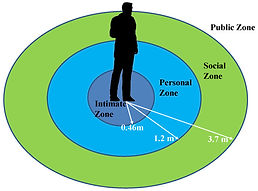
Zones of space in Proxemics

Representation of automobile impact points
Iterations
Creating the Party Setting:
Each Individual "partygoer" is denoted by a circle as well as their proxemic zone.
A spreadsheet was used to store points and data for each partygoer. The data stored was: Relationship, X and Y coordinates, emotion elicited, and response created. The individual’s color was changed based on their relationship.
Additionally, movement was created in the party with a sinusoidal equation to form pseudo-organic and naturalistic individual motion.

"Self" was represented by the mouse position.


Various Border & Styling Treatments were used


Organic border treatment was considered, to mimic natural space of people, but clashed with the otherwise circular design.


Dark Treatments were selected in the final version, to better resemble the feeling of a "party".
Creating the Body Response:
One major challenge encountered was creating a body which could dynamically respond to different bodily stimuli. This meant that the body had constituent parts and multiple modes. This challenge was solved by creating a by comprised of a set of points which could be manipulated by region.
To create this body, in a new p5.js sketch, I could draw body points by clicking to place a point which was controlled for body region. This was then converted from console output to a spreadsheet of points that can be then fed as data into the original sketch.


Placed 3,500+ data points

Dots could be styled and manipulated by region using the form.
Plotted all the points by region to create the figure.
Results
Different bodily reactions were created based on the nearest person and their relationship.


Reflections
The most interesting challenge was figuring out how to create the body and bodily response. Not only did this challenge require multiple considerations to decide on the dot-based figure, it required unique problem-solving skills to determine a setup in another p5.js sketch to build the body as a set of data points.
Another important technical constraint was storage. The 3,500+ points across a live animation created performance issues that required real tradeoffs including decreasing the frame rate, abandoning the audio component, and reducing the complexity of the animations. Working within those limits was its own design problem. With more time, I’d push further into the nuance of specific relationships and explore how those distinctions feel physically different from each other.